 |
| A Wollemi Pine at the U.S. Botanical Garden in Washington D.C. |
Showing posts with label rarity. Show all posts
Showing posts with label rarity. Show all posts
Thursday, June 28, 2012
Presumed extinct - WRONG!

Sunday, May 27, 2012
The Dragon's Blood Tree
 Sometimes nature provides such beautiful surprises in the forms and shapes it builds.
Dracaena cinnabari, or as it is commonly referred to, the dragon's blood tree, is found only on the Socotra islands, off the Horn of Africa and to the south of Yemen. As often happens in isolated ecosystems (think of the Galapagos) wondrous and diverse species developed on this archipelago.
These trees which resemble gargantuan mushrooms are actually a unique type of monocot, similar to palm trees. But different from all other monocotyledonous trees, the dragon's blood tree continuously branches, with leaves only forming at the ends of the young branches. This gives it its distinctive shape.
The name "dragon's blood" derives from its dark red resin which has numerous practical and medicinal uses for the natives.
Friday, May 11, 2012
Very, very old plants
 |
| ~1500 year-old Welwitschia mirabilis |
Tuesday, April 24, 2012
The giant misshapen phallus flower
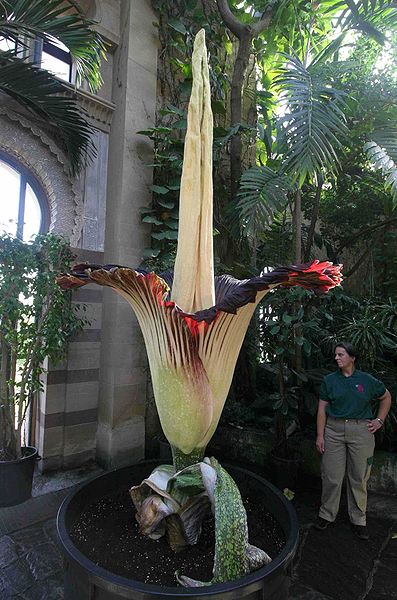 |
| Amorphophallus titanum |
Monday, March 26, 2012
The rarest plant on Earth
 |
| Encephalartos woodi (Wood's cycad) in the Amsterdam Botanical Gardens |
Thursday, March 22, 2012
Guest Blog: Michael Malice - The Plant As Celebrity: Whitesloanea crassa
Michael Malice is the subject of Harvey Pekar's graphic novel "Ego & Hubris" and co-author of five other books. He has over 200 succulent species in his Brooklyn apartment.
 If horticulture can be considered a form of entertainment, it is no surprise that the secondary elements of entertainment culture come with it. Take the case of Whitesloanea crassa, a monospecific Asclepiad / Stapeliad indigenous Somalia. In succulent circles, the species was treated as a celebrity. Old message boards contain cached references to "sightings" of the obscure and highly collectible species. There is Whitesloanea "trivia", as when pedantic horticulturists insist, incorrectly, that the genus is properly hyphenated since it named after White and Sloane. "Gossip" abounds about the plant: the Somali people, it is claimed, will kill you if you take it from the ground. The plant was notoriously "promiscuous"; for years the only material to be had was a cross with Huerniopsis decepiens. (Breeding across genera? Scandal!)
Much like many other "celebs" Whitesloanea's career has followed a familiar trajectory. Even five years ago, seedlings were impossible to find and sold quickly for $100 per. Thanks to the geometric growth of breeding populations, they can now be had for as little as $8--a drop of over 90%!--and are offered on eBay constantly. When it comes to plant collecting, Whitesloanea has become nothing more than a has-been.
Danny: This succulent is so rare that is has been basically unstudied by scientists. Over the past century there are only a handful of publications on Whitesloanea crassa. Most recently was a phylogenetic study published in 2000 that showed that Whitesloanea crassa is related to two other African succulents, Duvalia and Huernia.
Tuesday, February 21, 2012
A living fossil resurrected?
 |
| The ancient plant |
Subscribe to:
Posts (Atom)