Showing posts with label fruit. Show all posts

Sunday, September 30, 2012

The Citron of the Tabernacles

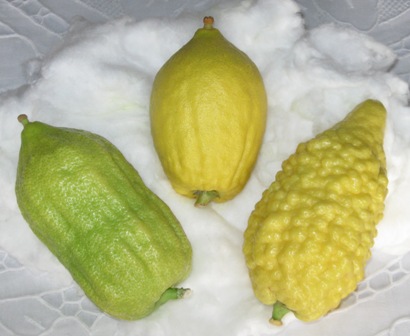
Varieties of Citron (citrus medica)
Oranges, grapefruits and lemons, tangerines, limes and maybe even a pomelo are types of citrus fruits we eat, or juice, all the time. But how many of you are familiar with the citron?

The citron has been around for thousands of years, and when crossed with other species, gave rise to the different citrus varieties we know and love today. But aside from its fragrance, the citron does not have many redeeming qualities, especially as it is almost devoid of juice and has a thick rind. While this can be candied to make succade, the citron's main uses have been religious.

The small etrog I bought for this year's Sukkot holiday
In the Book of Leviticus it is written: "And you shall take on the 1st day (of the Feast of Tabernacles, Sukkot) the fruit of beautiful trees...". The citron, known in Hebrew as the etrog, has always been assumed to be this fruit, as indeed the literal translation of the Hebrew word for "citrus" is eitz hadar, which literally translates as "beautiful tree". Because god commands us to use the etrog during the Feast of Tabernacles, the trade in citron, and especially beautiful unblemished fruit, can get competitive and expensive. The search for the perfect etrog was even the subject for an excellent movie, Ushpizin, which I highly recommend.

Happy Sukkot!

Sunday, September 16, 2012

An Apple for the New Year

"Why do we need so many kinds of apples? Because there are so many folks. A person has a right to gratify his legitimate taste. If he wants twenty or forty kinds of apples for his personal use…he should be accorded the privilege. There is merit in variety itself. It provides more contact with life, and leads away from uniformity and monotony." -- Liberty Hyde Baily

In the spirit of the Jewish New Year, some apple facts:
  • Origins: Khazakistan (Thanks Borat!) and surrounnding regions in Central Asia
  • # of genes (in Golden delicious): 57,000 (more than any other plant so far)
  • First eaten by: Eve
  • # of cultivars: 7,500
  • amount grown in 2010: 60 million tonnes
  • Largest grower: China
  • Largest grower in US: Washington

And lastly, for those going to a Rosh Hashana meal, here is the proper way to dip an apple in honey:


Wednesday, June 6, 2012

Native or Immigrant? The prickly pear's identity crisis

This is the flower which will develop into a prickly pear. The young fruit can be already seen growing under the flower, and a few more mature ones grow behind it.

Prickly pear cacti grow all over Israel and the Middle East in general, where they are used not only to produce the tasty fruit, but also as borders between houses and villages. The cactus is so omnipresent that most people think the prickly pear to be endogenous to the Middle East. Israelies have taken this one step further and have adopted the Hebrew name for the prickly pear (tzabar) (Sabra in English) to describe native born Israelis. Like the fruit, a tzabar is thought to be prickly and dangerous on the outside, but soft and sweet inside.

In reality though, the prickly pear may be an imposter. While it pretends to be native, it is actually a new immigrant (in Hebrew, an oleh). Molecular DNA studies indicated that the prickly pear of the Middle East, Opuntia ficus-indica, is actually an import from Mexico! Many European traders carried the prickly pear on board to prevent scurvy, and then transplanted the cacti around the Mediterranean. 

As a new immigrant, I can now proudly declare myself a tzabar !

Sunday, April 22, 2012

Methuselah, the 2000 year old date

The Methuselah date palm, 2012
Kibbutz Keturah, Israel
The date palm has been a source of food, medicine, shelter and shade for thousands of years. While the exact date trees grown in the bibical period are long extinct, in 2005, a 2000-year-old date seed recovered from Masada in the Judean dessert was successfully germinated. Genetic analyses have shown that this tree is distinct from all known date palms, and scientists want to see if the ancient tree has any unique medicinal properties no longer found in today's date palm varieties.


Unfortunately, Methuselah, true to its name, appears to be male, so we won't get any ancient fruit. Date palms are dioecious, meaning that there are separate male trees which make pollen, and female trees which make ovules which lead to fruit and seeds after fertilization with pollen from the male. But through careful genetic breeding, Methuselah can be used to pollinate modern species, and some of these offspring will be female. These hybrids can then be recrossed with Methuselah's pollen, to yield a new generation that's mainly the ancient date.

Sunday, April 15, 2012

Food for silk

Morus alba fruits
Morus alba (Mulberry)
The mulberry tree produces a tasty berry, but not because of this did the mulberry tree change history. Leaves of the mulberry tree are the sole food of the silkworm. 1400 silkworms eat 50 pounds of mulberry leaves to make just one pound of silk. The Chinese closely guarded the secret of silk production and so had a monopoly in supplying the great demand for silk by the Egyptians, Romans, Persians and other cultures. Trade of silk, and other wares, along the Silk Road from China through the Middle East and to Europe helped lay the foundations for the modern world.

Thursday, March 15, 2012

The cannonball fruit

Crescentia cujete fruit
Crescentia cujete fruit (Calabash tree)
The Calabash tree is found in tropical jungles of Central and South America. This tree produces a huge fruit that resembles (and weighs like) a cannonball. When fresh, the fruit is eaten. When dried and smoked, the fruit covering is used by native peoples as a container for food and liquids, as a cup, as a ladle, and even as a musical instrument (called the maraca). The fruit seeds contain an oil that's used as a medicine against colds.

Tuesday, February 14, 2012

Guest blog: Tovar Cerulli and Blueberries

Tovar Cerulli is an author and reformed vegan-turned-hunter. His book The Mindful Carnivore: A Vegetarian's Hunt for Sustenance was just released.

Blueberries
Wild blueberries Vaccinium corymbosum

Blueberries were my first wild food, and have remained my most constant.

As a boy, growing up here in New England, I sought them in the pine and oak woods around my father’s house. Small, sweet, and dusty blue, they hung in clusters, concealed by the leaves of the ground-hugging bushes. With a quart container filled, I would head back to the house, where my father mixed them into pancake batter, dropped by the ladleful onto a sizzling griddle.

In my twenties, as a vegan, I continued to pick them and savor the fullness of their taste.

Even today—when the wild foods in our kitchen include everything from white-tailed deer and fiddleheads to chanterelles and indigo milk caps—there is something special about stumbling onto a patch of blueberry bushes.

Heavy with fruit, they might cling to crevices in the rocky hillside my wife and I have been hiking. On a warm summer day, the berries come as unexpected gifts: morsels of transmuted earth, sun, and soil. I dig a plastic bag out of my pack and we start picking and snacking. Half an hour and two quarts later, we’ve hardly made a dent.

Walking away, we talk about what we’ll make with them. Yes, I’ll make some pancakes. Yes, Cath will make a batch of jam. Assuming enough berries make it back to the kitchen.

Danny: Blueberries are native to North America. They are often confused with the European bilberries, which while similar in appearance and taste, are a different species. While blueberries are obviously essential for muffins and pancakes, a recent study has indicated that daily blueberry consumption can improve memory functioning, at least in older adults with impaired memory.
Monday, February 6, 2012

Guest Blog: Yuval Sapir - Mr. and Ms. Almond


Almond trees bloom in the midst of winter, exposed to rain and wind. This is also the same time of the year that has an almost complete lack of pollinators. So how do these trees make fruits?

Well, on rare sunny winter days, these trees are visited by large solitary Anthophora bees. Each bee can visit a single tree hundreds of times. But even with these visits of pollinators, only a tiny fraction (5 - 10%) of flowers set fruit, which seems like a huge waste of flowers. Why such a waste?

The answer is probably due to the difference between males and females (I'm talking about trees here, but the case could be made for humans as well). Males seek different paths of reproductive success than females. The male parts of the almond trees (which produce the pollen) benefit from each bee visit as more and more pollen is spread to other trees. The huge number of flowers is a very attractive advertisement for the bees to come get pollen. The larger the advertisement, the better chances of male success. The large cover of thousands flowers attracts many more bees that carry pollen away, which increases the chances of male success.

The female parts of the tree (which is the style and ovules), on the other hand, enjoys the privilege of "choosing" the best pollen grains and being picky. Only the most fit male will make it to the ovule and produce a fruit, otherwise an abortion will be its fate. So only a twentieth of flowers set fruits, but these will be the best kids for mom!

Saturday, December 31, 2011

Champagne from black grapes?

Pinot Meunier
Vitis vinifera (Pinot Noir grapes)
Much of the champagne drunk tonight will have been made not from white grapes, but actually from black grapes of the Pinot Noir and Pinot Mernier varieties, grapes usually associated with deep red wines. Black grapes like Pinot Noir have a white flesh, which under the correct harvest and production conditions yield a light colored juice. This juice is fermented in the bottle to produce the bubble drink many of us will consume tonight. Happy New Year!