Showing posts with label guest. Show all posts

Sunday, January 20, 2013

Guest Blog: Yunal Sapir and The Shy Red Bride

Anemone coronaria
Dr. Yuval Sapir is Director of the Tel Aviv University Botanical Gardens

The red-crowned anemone, Anemone coronaria, is one of the most common and beloved wildflowers in Israel. It's Hebrew name, Kalanit, is from the Hebrew word for bride, dressed beautifully in a red dress. From January through March, red carpets of anemones cover the hills in the Mediterranean region, with beetles buzzing in and out the flowers. These are glaphyrid beetles that are adapted to forage pollen and to mate on the red, bowl-shaped anemone flowers. The beetles are attracted by the large amount of pollen in the numerous anthers of the flower. While eating or mating inside the flowers, their body is covered with pollen grains that transferred on to the next flower.

Anemone flowers live for two weeks, but only in the start is the stigma receptive to accept pollen grains. Although the flowers are hermaphrodite, containing both sexes in the same plant, the female (stigma) is matures earlier than the male (pollen), effectively mandating that sex has to be between two different flowers. When the male function is active in the flower, there are other younger flowers that have their stigma ready. Interestingly, during its two-weeks life time, the anemone's flower keeps growing. Young, female flowers are small and perfectly red. Later on, the male flower is larger and also develops white ring around the center where the pollen is available for the pollinating beetles. Of-course, the male function of the flower benefits from being prominent on the white background. The more seen, the more visits and the more pollen grains spread out to females. The female function, on the other side, needs very little number of visits, because one pollen grain fertilizing an ovule is enough to make a seed. So no need to be prominent like the male; the small red flower is just enough to get pollen. The shy female will get what it needs soon enough.

Sunday, January 6, 2013

Guest Blog: Yuval Sapir and 50 Shades of Pink

A field of wild anemones flowering in early January.
Note that most of the flowers are not red.
Dr. Yuval Sapir is Director of the Tel Aviv University Botanical Gardens

The crowned anemone, Anemone coronaria, is well-known for its red flowers. But its flowering season, January to March, is also characterized by non-red anemone flowers, particular early in the season. 

While the red flowers are pollinated by glaphyrid beetles, the non-red ones are pollinated by any possible insect hovering around in the winter. All except beetles. But no worries - beetles are anyhow not around in this early period of the winter (January). Indeed, the non-red anemones flower earlier than the red ones, even where they grow in the same place. 

Another difference between the two types (red and non-red) is that while the red ones are common everywhere, from extreme desert to the northernmost Mediterranean parts of Israel, the non-red anemones are unique to humid Mediterranean ecosystems. This is probably due to drought tolerance trait linked to the red-color allele. The genetic system for the color of the anemone includes two possibilities (alleles): red, or non-red. Red is recessive, this means that a only if both alleles are red, the flowers are red. If one of the alleles is non-red, the flower will be any other shade of pink, from white to purple. Despite the superiority of the non-red alleles, they are non-exist in the southern populations, in the dry Mediterranean and in the desert. This linkage between flower color and environmental adaptation is interesting, and has not been extensively studied.

Monday, September 3, 2012

Guest blog: Jonathan Gressel - Exposing anti-GMO propaganda veiled as science

Danny: The following is a public letter written by my colleague Prof. Jonathan Gressel at the Weizmann Institute, in response to talk from an ecologist decrying the use of transgenics in agriculture. I edited the letter, shortening it for use here. I should point out that Dr. X. is a zoologist at a well known university. As the gossip is less important than the content, I decided to leave her anonymous as "X" here.   I should also point out that no response was received from "X" to this letter.

Dear Dr X,

I was rather disturbed by some of the disinformatory remarks that you made yesterday at the symposium [Genetic Engineering in Agriculture - Dream or Necessity?], especially in relationship to transgene flow. You categorically stated that there have been no studies on this (or any) area of ecology/population genetics of transgenics in Israel. My students, colleagues, and I have published over 40 papers on the subject since 1999 demonstrating that you have hardly done your homework  - or in the parlance of journal editors - this is an ethical defect known as "citation amnesia".

You also made dire warnings about gene flow (via pollen or seed) to the wild, and claimed in a slide that there was evidence for this. A careful reading of the data behind the slide would have led you to a different conclusion. Competent ecologists distinguish between agro-ecosystems, ruderal (human-disturbed) ecosystems, and wild ecosystems. There is no published evidence that there has been gene flow to any wild ecosystem, and as you should know, there are exceedingly few instances of crops growing anywhere near wild interbreeding relatives. The real issue is gene flow to weeds in agroecosystems, which is controllable, and regulators should assure that there are transgenic failsafe mechanisms installed to prevent such problems.

You implied that organic agriculture is incompatible with transgenics - I strongly suggest that you read the book co-authored by a professor of organic agriculture, and head of the program at UC-Davis, who rather considers otherwise [Tomorrow’s Table: organic Farming, Genetics and the Future of Food. Pamela C. Ronald and Raoul W. Adamchak].

You also implied that there was a consensus among ecologists that transgenics were highly dangerous (I believe you put it as "all the ecologists I talked with"). There are highly competent ecologists (including the only ecologist among the founders of Greenpeace) who argue strongly for transgenics as being an exceedingly invaluable tool for protecting the environment [Confessions of a Greenpeace Dropout: The Making of a Sensible Environmentalist].

Indeed many meta-analyses performed by ecologists have shown the distinct environmental benefits of transgenics over current conventional agricultural practices (and even moreso over organic agriculture).

Thus, it is hard to conclude that you presented an impartial review of the ecological implications of transgenics that would have been expected of an academic ecologist at an important university.

This is very unfortunate.

Sincerely,

Prof. Jonathan Gressel
Plant Sciences
Weizmann Institute of Science
Rehovot, Israel 76100

Sunday, July 15, 2012

ReBlog - The Legumes of War: How Peanuts Fed the Confederacy


I found this on Smithsonian.com.  Rather than summarize, I'm just showing the entire blog post. the original link is http://blogs.smithsonianmag.com/food/2012/04/the-legumes-of-war-how-peanuts-fed-the-confederacy. Good thing for the confederacy that peanut allergies are a modern epidemic!


April 19, 2012

The Legumes of War: How Peanuts Fed the Confederacy


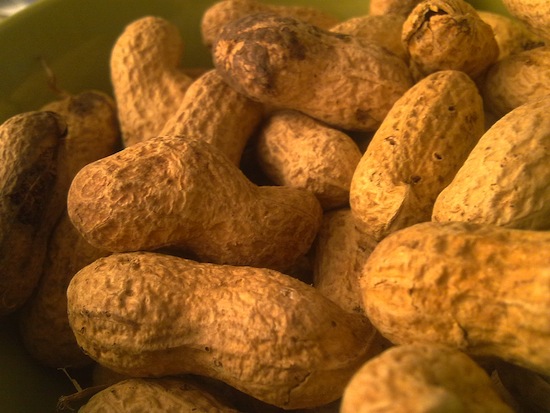
Peanuts. Image Courtesy of Flickr user La.blasco.
When it came to fighting the Civil War, the South may have been rich in military leadership, but the North had superior resources, especially when it came to industrial strength. Still a largely agrarian society, the Southern states had to import most of their manufactured products, and with a poor railway system, keeping troops well-stocked was a battle in and of itself, especially when enemy blockades interrupted supply lines. Combined with inflation and scorched-earth military campaigns—such as General Sherman’s march through South Carolina—food shortages were a problem for both military and civilians. But even in those hard times, people could find relief in peanuts.
Before the Civil War, peanuts were not a widely cultivated crop in the United States—Virginia and North Carolina were the principal producers—and were generally viewed as a foodstuff fit for the lowest social classes and for livestock. When they were consumed, they were usually eaten raw, boiled or roasted, although a few cookbooks suggested ways to make dessert items with them. The goober pea’s status in the Southern diet changed during the war as other foods became scarce. An excellent source of protein, peanuts were seen as a means of fighting malnutrition. (And they still are, with products such as Plumpy’nut being used in famine-plagued parts of the world.) In addition to their prewar modes of consumption, people used peanuts as a substitute for items that were no longer readily available, such as grinding them to a paste and blending them with milk and sugar when coffee was scarce. “This appreciation [for peanuts] was real,” Andrew F. Smith wrote inPeanuts: The Illustrious History of the Goober Pea. “Southerners continued to drink peanut beverages decades after the war ended.” Peanut oil was used to lubricate locomotives when whale oil could not be obtained—and had the advantage of not gumming up the machinery—while housewives saw it as a sound stand-in for lard and shortening as well as lamp fuel.
Peanuts became ingrained in the culture, going so far as to crop up in music. For Virginian soldiers wanting to take a dig at North Carolina’s peanut crop, there was:
The goobers they are small
Over thar!
The goobers they are small
Over thar!
The goobers they are small,
And they digs them in the fall,
And they eats them, shells and all,
Over thar!
The humorous song “Eatin’ Goober Peas” also surfaced during the war wears. (You can hear the song in full as performed by Burl Ives and Johnny Cash.)
Just before the battle the General hears a row,
He says, “The Yanks are coming, I hear the rifles now,”
He turns around in wonder, and what do you think he sees?
The Georgia militia eating goober peas!
There is also an account of a July 1863 episode where the Confederate Army’s Fifth Company of the Washington Artillery of New Orleans was entrenched in Jackson, Mississippi, and burned down a mansion in order to clear their view of the battlefield—although not before saving a piano. As the Union Army drew nearer, one soldier took to the ivories, encouraging his compatriots to join in song, including a round of “You Shan’t Have Any of My Peanuts”:
The man who has plenty of good peanuts,
And giveth his neighbor none,
He shan’t have any of my peanuts when his peanuts are gone.
While the Fifth Company succeeded in keeping the enemy at bay that day, peanuts just weren’t enough to save the Confederacy in the long haul.


Sunday, July 1, 2012

Yuval Sapir: When plants move - seeds on my sock

Dr. Yuval Sapir is Director of the Tel Aviv University Botanical Gardens 


As taught in basic biology classes, plants differ from animals in several substantial ways, including mobility. While animals are mobile and can choose their environment, plants are stationary, rooted in one place.


However, while this might be true for an individual plant, on a different level, plant do indeed move, just at a different speed and with unexpected parts.  


While animals move their entire body, including all related organs, plants move only their embyos. Plants pack their embryos in a bag that is on the one hand resistant to environmental harshness, and on the other hand "opens" immediately to the right set of cues, which are a complex mixture of light, temperature and moisture. This package is of course the seed. This is the real moving part of the plant, moving sometime as far and as rapid as animals do, and even more.


Seed movement requires agents of transportation, and different types of seeds are adapted to different agents of transportation. These could be physical, such as wind, carrying light-weight seeds (sometimes equipped with wing-like appendices) to circle the globe like dust. Such are, for example, seeds of orchids. Animals, just to close the circle, are good transportation agents because they... well, move. Fury animals, like dogs and cats, are especially adept at transporting seeds, as so also are, surprisingly, (relatively) hairless humans.  In place of fur, our clothes become the furry vehicle that seeds hitch a ride on. See the picture of my leg, my sock covered with seeds of Daucus carota (the wild carrot) and other seeds. All are spiny and adapted to catch the fur on my (or on other mammal's) leg.

Thursday, June 14, 2012

Guest Blog Linda Leaming: Meeting Himalayan Medicinal Plants


Linda Leaming lives in paradise. Her book MARRIED TO BHUTAN is the story of her life in one of the most magical and beautiful places on earth, the Himalayan Kingdom of Bhutan.

The caretaker's garden
I never feel more happy or alive than when I'm walking in the mountains of Bhutan. One of my favorite walks is to WangdueTse (Wang-d-SAY), a famous, old temple on the outskirts of Thimphu with giant iron statues and an ancient mud floor. It takes half a day from my house in the hills above the city, and it's a marvelous escape into another world. The hike takes me down the big hill where we live, around the bend and then up the switchback road to Sangaygang (San-GAY-gang). At Sangaygang, high above the city, I walk past the caretaker's cottage and note his nice garden, and then it's over a big mound and I'm in the woods headed to the temple.

Khempa (Tibetan Sage)


Surrounded by the forest, there's that insular, rich aroma of nature and life. Rotting plants, pine sap, urine, fresh air, flowers, and wood smoke, all blend together, and it's the smell I love most. One plant, called khempa by the Bhutanese, is gloriously making itself known on the edge of the trail this spring morning. It has a sort of pungent, musky, eucalyptus smell and is used liberally here as a medicinal plant. A spoonful of the juice helps with sinusitis, and a hot bath with an armful of its leaves will cure back pain. Bhutan in the Himalayas is the land of medicinal plants. There are over of them 500 cataloged, and many as yet unrecorded. In Thimphu we live near the Traditional Hospital, which uses many traditional herbs and plants for healing. Here's a blog post I wrote about going to the traditional hospital.
    

Friday, May 4, 2012

Guest Blog: Dr. Yuval Sapir and the Lily from the mountains

Lilium candidum - Madonna lily
Dr. Yuval Sapir is Director of the Tel Aviv University Botanical Gardens 


The crusaders fell in love with the large white, trumpet-like flower of Lilium candidum when they arrived in the middle east. These christian believers immediately took the lily as the sign of the Annunciation, when according to Christian lore, the Angel Gabriel told Mary that she would give birth to the son of God.

What could cause these European religeous warriors to consider the lily the flower of the Annunciation?

Well, lilies flower religiously (all pun intended) towards the end of March. Count nine months forward from the end of March, and you get December 25. So of course the flowering of this marvelous flower must have religious meaning. Thus they termed this majestic, pure white flower the Madonna Lily.

The Crusaders picked and shipped thousands of Madonna Lilies back to Europe, where its cultivation failed miserably. Over the years, another species of Lily - Lilium longiflorom - was adopted as a proxy for the Madonna Lily. This species is from Eastern Asia, and defined (as the name hints) by longer flowers than the Middle-Eastern lily.

The Madonna Lily still grows naturally in Israel in the upper Galilee and on cliffs in the high Mount Carmel. It is among the rare and endangered plants in Israel, but also among the most pilgrimaged ones, because of her beauty. It became the symbol of the Tel Aviv University Botanical Garden, based on a picture that Prof. Jacob Galil, the founder of the garden, took in the 1950's.

Thursday, March 22, 2012

Guest Blog: Michael Malice - The Plant As Celebrity: Whitesloanea crassa

Michael Malice is the subject of Harvey Pekar's graphic novel "Ego & Hubris" and co-author of five other books. He has over 200 succulent species in his Brooklyn apartment.

If horticulture can be considered a form of entertainment, it is no surprise that the secondary elements of entertainment culture come with it. Take the case of Whitesloanea crassa, a monospecific Asclepiad / Stapeliad indigenous Somalia. In succulent circles, the species was treated as a celebrity. Old message boards contain cached references to "sightings" of the obscure and highly collectible species. There is Whitesloanea "trivia", as when pedantic horticulturists insist, incorrectly, that the genus is properly hyphenated since it named after White and Sloane. "Gossip" abounds about the plant: the Somali people, it is claimed, will kill you if you take it from the ground. The plant was notoriously "promiscuous"; for years the only material to be had was a cross with Huerniopsis decepiens. (Breeding across genera? Scandal!)

Much like many other "celebs" Whitesloanea's career has followed a familiar trajectory. Even five years ago, seedlings were impossible to find and sold quickly for $100 per. Thanks to the geometric growth of breeding populations, they can now be had for as little as $8--a drop of over 90%!--and are offered on eBay constantly. When it comes to plant collecting, Whitesloanea has become nothing more than a has-been.

Danny: This succulent is so rare that is has been basically unstudied by scientists. Over the past century there are only a handful of publications on Whitesloanea crassa. Most recently was a phylogenetic study published in 2000 that showed that Whitesloanea crassa is related to two other African succulents, Duvalia and Huernia.

Tuesday, March 6, 2012

Guest Blog: Yuval Sapir and Iris SROs

Dr. Yuval Sapir is Director of the Tel Aviv University Botanical Gardens

Royal Irises are among the most prominent flowers to bloom in the Israeli Spring. This group of species includes the largest flowers in the Middle East, with some as large as Mike Tyson's boxing gloves. Not only large, these flowers are oddly dark-colored. For example, the Gilboa Iris (Iris haynei [picture]) is purple, and other species can be as dark as black. How did this conspicuous dark color evolve?

These huge flowers double as SROs (single room occupancy units) for solitary male bees that sleep overnight in the flowers. These poor males are not allowed in the safe borrows of the females, who nest in the ground. Instead, they are banished for the night to look for a safe refuge from their predators. Iris flowers provide the perfect hospice. Following sunrise, rays from the morning sun heat the dark-colored flowers.  The inside of the flower quickly heats up, and with it, the resident sleeping bee. The warmed-up bee can then start its daily activities earlier than colder bees which slept outside. On its way out of the Iris, the bee picks up some pollen, which it carries around with him in its search for food (nectar) and sex (female bees).

The following evening, tired from his day and still carrying the Iris pollen, the male remembers to go back to his safe and warm Iris-shelter. Upon entering the flower, the pollen-carrying male brushes against the flower's stigma, pollinating the flower.

So here we have the answer to the evolution of the dark-colored irises - the dark color was selected for by the pollinators who preferred a night shelter that promise them a warm place to wake-up in.

Tuesday, February 14, 2012

Guest blog: Tovar Cerulli and Blueberries

Tovar Cerulli is an author and reformed vegan-turned-hunter. His book The Mindful Carnivore: A Vegetarian's Hunt for Sustenance was just released.

Blueberries
Wild blueberries Vaccinium corymbosum

Blueberries were my first wild food, and have remained my most constant.

As a boy, growing up here in New England, I sought them in the pine and oak woods around my father’s house. Small, sweet, and dusty blue, they hung in clusters, concealed by the leaves of the ground-hugging bushes. With a quart container filled, I would head back to the house, where my father mixed them into pancake batter, dropped by the ladleful onto a sizzling griddle.

In my twenties, as a vegan, I continued to pick them and savor the fullness of their taste.

Even today—when the wild foods in our kitchen include everything from white-tailed deer and fiddleheads to chanterelles and indigo milk caps—there is something special about stumbling onto a patch of blueberry bushes.

Heavy with fruit, they might cling to crevices in the rocky hillside my wife and I have been hiking. On a warm summer day, the berries come as unexpected gifts: morsels of transmuted earth, sun, and soil. I dig a plastic bag out of my pack and we start picking and snacking. Half an hour and two quarts later, we’ve hardly made a dent.

Walking away, we talk about what we’ll make with them. Yes, I’ll make some pancakes. Yes, Cath will make a batch of jam. Assuming enough berries make it back to the kitchen.

Danny: Blueberries are native to North America. They are often confused with the European bilberries, which while similar in appearance and taste, are a different species. While blueberries are obviously essential for muffins and pancakes, a recent study has indicated that daily blueberry consumption can improve memory functioning, at least in older adults with impaired memory.

Thursday, February 9, 2012

Guest Blog: Mollie Cox Bryan and Morning Glories

Mollie Cox Bryan is an author, scrap-booker, blogger and childhood friend. The first book in her new mystery series, A SCRAPBOOK OF SECRETS, was just published.
Blue Morning glories
Add caption
Are Morning Glories sneaky? I confess that sometimes I really think certain plants and flowers have a personality. I love the flowers—the vibrant colors, the way they open in the morning and then fold during the day. Part of the joy I take in them is that they are little survivors and opportunists, popping up everywhere in my backyard—which is exactly what my husband hates about them. Where I see a charm, he sees the need for order. Oh well. But the little sneaky, beautiful flower has found its way into my first novel—SCRAPBOOK OF SECRETS: A CUMBERLAND CREEK MYSTERY. The copy editor asked why so many Morning Glories. (Perhaps copy editors and orderly husbands have something in common?) I responded that I live in Virginia, my book is set in Virginia, and I love the flower. She didn’t press the issue—so my Morning Glories are safe, at least in my novel.

Danny: There are hundreds of different varieties of Morning Glories. One Japanese variety, Shidare-asagao, is particularly interesting for scientists because it has lost its balance. Plants, like people, have a sense of balance that allows them to know up from down. Just as we know when we're upside down, or just lying down, a plant also knows when its not vertical. Plants shift their growth according to gravity. That's why plant shoots always grow up, and roots always grow down (you can test this at home by placing a plant and its pot on its side). Shidare-asagao though has lost its sense of gravity. Rather than growing up, its shoots fall down. This makes for a great hanging plant.

Monday, February 6, 2012

Guest Blog: Yuval Sapir - Mr. and Ms. Almond


Almond trees bloom in the midst of winter, exposed to rain and wind. This is also the same time of the year that has an almost complete lack of pollinators. So how do these trees make fruits?

Well, on rare sunny winter days, these trees are visited by large solitary Anthophora bees. Each bee can visit a single tree hundreds of times. But even with these visits of pollinators, only a tiny fraction (5 - 10%) of flowers set fruit, which seems like a huge waste of flowers. Why such a waste?

The answer is probably due to the difference between males and females (I'm talking about trees here, but the case could be made for humans as well). Males seek different paths of reproductive success than females. The male parts of the almond trees (which produce the pollen) benefit from each bee visit as more and more pollen is spread to other trees. The huge number of flowers is a very attractive advertisement for the bees to come get pollen. The larger the advertisement, the better chances of male success. The large cover of thousands flowers attracts many more bees that carry pollen away, which increases the chances of male success.

The female parts of the tree (which is the style and ovules), on the other hand, enjoys the privilege of "choosing" the best pollen grains and being picky. Only the most fit male will make it to the ovule and produce a fruit, otherwise an abortion will be its fate. So only a twentieth of flowers set fruits, but these will be the best kids for mom!

Monday, January 2, 2012

Guest Blog: Paul Moore and the Mt. Atlas Pistachio

Paul Moore is a musician, traveling minstrel, founder of Ukuleles for Peace, and a lover of trees.

Pistacia atlantica
Paul Moore and a very old Pistacia atlantica (Mt. Atlas mastic)

Paul: I found this today while on a trip to look at stone for my house. This amazing Mount Atlas Pistache tree is next to Kibbutz Yiftah on the Northern Road of Israel. This could be the oldest one in the grove, or one like it, and is approximately 450yrs old. The most strange thing happened as I approached it: a Black cat jump out from the Center of the Tree... A witch's Tree no doubt! I am lucky to Live in a Forest in the Galilee Mountains in Mitzpa Harashim, We take our love of trees very seriously here! I hope to take pictures and tell more tree story's in the Future. The Galilee has an amazing amount of very old trees despite its size and the constant removal of trees over the centuries for fire, carpentry and more recently the railway. The Sacredness of some trees is still very much part of the inhabitants, be they Jew, Christian, Druze, or Muslim.

Danny: This species of pistachio is native from Iran to Turkey, through the Middle East to North Africa. It has many uses: The seeds can be eaten raw or turned into candy, the seeds also provide a useful oil, the plant contains a rubber that is used as a natural chewing gum, its sap is used to make incense and perfume, and the leaves contain chemicals used for tanning leather. The Mt. Atlas tree is dioecious, meaning that there are separate male and female trees.