Showing posts with label flower. Show all posts

Monday, April 1, 2013

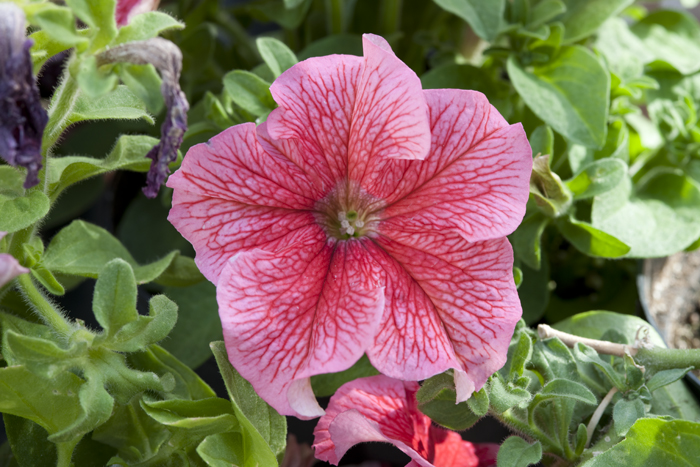
No sibling rivalry for Petunias

NOTE: THIS WAS ORIGINALLY PUBLISHED ON APRIL 1, 2013!

Petunias grown in a nursery together with their sibling petunias thrived much better post-separation than did a single petunia grown on its own. This conclusion jives with numerous studies which show that puppies kept with their litter-mates for at least 8 weeks develop better than puppies separated from their siblings soon after birth, and also fits with accumulating evidence showing the importance to human development of keeping a baby in physical contact with people, rather than isolating a baby in a crib.

Seeds of Petunia hybrida were germinated in two different environments. In the green house termed “Petunia Patch”, the seeds were sown 5 cm from each other.
Petunias in the "Petunia Patch"

In the second green house termed “Onion Patch”, individual petunias were planted at least 50 m from each other. 5, 10, 20 and 45 days post-germination, individual plants from the Petunia Patch were transplanted to the Onion Patch. Control plants remained in each plot from germination until the end of the experiment. Each plot received the same watering and fertilizer regimen. Growth parameters (germination rate, height, leaf number, flowering time, flower diameter, seed set) were gathered daily over a two-month period.

The results were astounding. The longer the petunia stayed in the Petunia Patch, the more the individual plants thrived (see graph on left). The effect was especially significant for the first 10 days. Most of the petunias germinated in the Onion Patch, or transplanted early in life, failed to thrive. When asked to comment on the flowers that didn’t bloom, Drs. John N.Kamano, William E. Faber and Maurice Merl  said, “They were just lonely little petunias in an onion patch”.

These results have implications for home gardeners who are asked to purchase neighboring petunias in their local nursery so as to lessen the separation stress of plants upon leaving the nursery.

Sunday, January 20, 2013

Guest Blog: Yunal Sapir and The Shy Red Bride

Anemone coronaria
Dr. Yuval Sapir is Director of the Tel Aviv University Botanical Gardens

The red-crowned anemone, Anemone coronaria, is one of the most common and beloved wildflowers in Israel. It's Hebrew name, Kalanit, is from the Hebrew word for bride, dressed beautifully in a red dress. From January through March, red carpets of anemones cover the hills in the Mediterranean region, with beetles buzzing in and out the flowers. These are glaphyrid beetles that are adapted to forage pollen and to mate on the red, bowl-shaped anemone flowers. The beetles are attracted by the large amount of pollen in the numerous anthers of the flower. While eating or mating inside the flowers, their body is covered with pollen grains that transferred on to the next flower.

Anemone flowers live for two weeks, but only in the start is the stigma receptive to accept pollen grains. Although the flowers are hermaphrodite, containing both sexes in the same plant, the female (stigma) is matures earlier than the male (pollen), effectively mandating that sex has to be between two different flowers. When the male function is active in the flower, there are other younger flowers that have their stigma ready. Interestingly, during its two-weeks life time, the anemone's flower keeps growing. Young, female flowers are small and perfectly red. Later on, the male flower is larger and also develops white ring around the center where the pollen is available for the pollinating beetles. Of-course, the male function of the flower benefits from being prominent on the white background. The more seen, the more visits and the more pollen grains spread out to females. The female function, on the other side, needs very little number of visits, because one pollen grain fertilizing an ovule is enough to make a seed. So no need to be prominent like the male; the small red flower is just enough to get pollen. The shy female will get what it needs soon enough.

Sunday, January 6, 2013

Guest Blog: Yuval Sapir and 50 Shades of Pink

A field of wild anemones flowering in early January.
Note that most of the flowers are not red.
Dr. Yuval Sapir is Director of the Tel Aviv University Botanical Gardens

The crowned anemone, Anemone coronaria, is well-known for its red flowers. But its flowering season, January to March, is also characterized by non-red anemone flowers, particular early in the season. 

While the red flowers are pollinated by glaphyrid beetles, the non-red ones are pollinated by any possible insect hovering around in the winter. All except beetles. But no worries - beetles are anyhow not around in this early period of the winter (January). Indeed, the non-red anemones flower earlier than the red ones, even where they grow in the same place. 

Another difference between the two types (red and non-red) is that while the red ones are common everywhere, from extreme desert to the northernmost Mediterranean parts of Israel, the non-red anemones are unique to humid Mediterranean ecosystems. This is probably due to drought tolerance trait linked to the red-color allele. The genetic system for the color of the anemone includes two possibilities (alleles): red, or non-red. Red is recessive, this means that a only if both alleles are red, the flowers are red. If one of the alleles is non-red, the flower will be any other shade of pink, from white to purple. Despite the superiority of the non-red alleles, they are non-exist in the southern populations, in the dry Mediterranean and in the desert. This linkage between flower color and environmental adaptation is interesting, and has not been extensively studied.

Sunday, August 26, 2012

Invading garlic

Allirai petiolata (garlic mustard)
Garlic mustard is native to Europe, western and central Asia, and nothern Africa. As a biennial, in the first year of growth, plants form clumps of round shaped, slightly wrinkled leaves, that when crushed smell like garlic (hence the name...). The next year plants flower in spring, producing white flowers that release seeds in mid-summer.

Garlic mustard leaves are a great addition to wild salads, providing a mild flavour of both garlic and mustard. Garlic mustard was once used medicinally as a disinfectant or diuretic, and was sometimes used to heal wounds.

In the late 19th century garlic mustard was introduced in North America as a culinary herb, and since has gone on to become a very problematic invasive species. The success of garlic mustard, like that of other invasive species, is due to its lack of native competitors. Garlic mustard produces a variety of compounds that reduces its palatability to herbivores. Interestingly, in its native habitats, some herbivores have co-evolved to feed happily on the plants. But these insects and fungi that feed on it in its native habitats are not present in North America, and this leads to more garlic mustard seeds, allowing it to out-compete native plants. Even white-tailed deer, the scourage of many Eastern woodlands, don't eat the garlic mustard, preferring neighboring plants, which frees even more space for the garlic mustard to spread.


Monday, August 20, 2012

The Harbinger of Summer's End

Sea squill (Drimia maritima)
My favorite plant is easily the sea squill, which in Hebrew is called hatzav (with a hard "h" like your clearing your throat). The sea squill is wondrous because it grows and flowers like a Swiss clock in August in Israel, heralding the end of the summer and the approaching fall. Out of nowhere, the hatzav sprouts and rapidly grows a two-to-three-foot stalk with hundreds of little white flowers. The flowers open over several weeks progressively from the base to the tip, resulting in a very impressive floral display.

How does the hatsav know when August has arrived? It knows this because of the lengthening nights. The sea squill is what's known in scientific terms as a "short day" plant, which is a misnomer, as they are actually "long night" plants. "Short day" plants like sea squill and tobacco flower when the length of the night surpasses a threshold specific for that plant. This is as opposed to "long day" plants like carnations and oats, which flower when the night gets shorter than a set threshold.

Plants "know how long the night is thanks to a group of photoreceptors called phytochromes. In a simple model, phytochromes are activated by red light, and are turned on in the morning; they are deactivated by far-red light, the long waves at the end of sunset, so are turned off as night begins. Plants measure the time the phytochromes are turned off, and use this information to determine season.

Sea squill leaves in winter
Getting back to the seq squill, its floral stalk has no leaves, so where does this plant get energy from photosynthesis? The sea squill has two different life cycles. In the summer and fall, it flowers, but in the winter, when there's pleanty of water for to support photosynthesis and growth it produces large green leaves. Theses leaves produce the sugars that are stored underground in a large bulb. As the dry season starts these leaves wilt and dry up. But the bulb uses these stored sugars as energy to produce the flowering stalk in August.

Monday, July 9, 2012

An enigmatic petunia

I love when performance art and hardcore science meet.

Enigma is a petunia that was genetically engineered by the artist Eduardo Kac. Enigma is a normal petunia except its genome contains one of Kac's genes, specifically the gene called IGK. This gene encodes for part of the imunoglobulin protein which functions in our immune system. Kac engineered engima so that it expresses his IGK gene, but only in the flower's veins. He did this by first cloning the IGK gene behind a promoter from a plant virus which is usually only turned on in plant veins. This is a rather simple but cool project that can be carried out in most plant molecular biology labs.


Eduardo Kac, Natural History of the Enigma, transgenic flower with artist's own DNA expressed in the red veins, 2003/2008. Collection Weisman Art Museum. Photo: Rik Sferra.


In the picture or enigma  the red color signifies where his IGK gene is being expressed. While this is visually pleasing, its also a bit misleading, leading the unwary reader to think this "red" is due to blood. While Kac isolated his IGK gene from his own blood, imunoglobulins are colorless. The reason enigma's veins is not due to Kac's gene, but rather due to a plant gene which controls the expression of genes necessary for making anthocyanins, the plant's red pigments.


Kac calls enigma a "plantimal, a new life form [he] created that ... is a hybrid of myself and Petunia".


This is also could be misleading. Enigma is not a "hybrid", which implies a true mixing of parts [see comments below]. Enigma is at best 0.003% Kac, 99.997% petunia. Considering that plants contain many genes normally thought of as human, such as BrcA and Cftr (encoding the genes for breast cancer and cystic fibrosis), perhaps all plants are actually "plantimals". Or maybe considering that humans normally contain many genes originally thought of as plant, such as Det1 and Cop9 (genes necessary for photomorphogenesis, plant development in the light), maybe we ought to be considered "aniplants"?

In any event, I think Kac is to be applauded for pushing the boundaries of art and science, and for carrying out research project which well exemplifies how genetic engineering works! If you're interested, you can by your own enigma seeds on Kac's website.

Tuesday, May 15, 2012

Pretty but poisonous

Calia secundiflora flowers
Sophora secundaflora (Texas mountain laurel)
The Texas Mountain Laurel is a lovely small tree with bunches of bright blue flowers. These flowers yield bright red seeds which Native Americans used as ornaments and jewelry, but also as an hallucinogen. The seeds can be used to make a drink which when dilute leads to hallucinations, but at higher doses is poisonous. The toxic compound, cytisine, causes paralyses which leads to suffocation.

Monday, May 7, 2012

Yesterday-today-and-tomorrow

Brunfelsia pauciflora (carllewis)
Brunfelsia pauciflora (yesterday-today-and-tomorrow)
The Brunfelcia is a small shrub with beautiful pansy-like flowers. Yesterday-today-and-tomorrow is aptly named as its flowers begin life with a deep purple color which change to lavender, and finally fade away to white. While native to Brazil, this evergreen shrub has been cultivated and is used in gardens indoors and out. It also contains a neuro-active drug called "scopoletin". Animals or people who mistakenly eat this plant develop an irregular heart rate, dryness of the mouth, dilated pupils, and in rare cases, coma. In controlled dosage, this chemical can be used as a medicine.

Friday, May 4, 2012

Guest Blog: Dr. Yuval Sapir and the Lily from the mountains

Lilium candidum - Madonna lily
Dr. Yuval Sapir is Director of the Tel Aviv University Botanical Gardens 


The crusaders fell in love with the large white, trumpet-like flower of Lilium candidum when they arrived in the middle east. These christian believers immediately took the lily as the sign of the Annunciation, when according to Christian lore, the Angel Gabriel told Mary that she would give birth to the son of God.

What could cause these European religeous warriors to consider the lily the flower of the Annunciation?

Well, lilies flower religiously (all pun intended) towards the end of March. Count nine months forward from the end of March, and you get December 25. So of course the flowering of this marvelous flower must have religious meaning. Thus they termed this majestic, pure white flower the Madonna Lily.

The Crusaders picked and shipped thousands of Madonna Lilies back to Europe, where its cultivation failed miserably. Over the years, another species of Lily - Lilium longiflorom - was adopted as a proxy for the Madonna Lily. This species is from Eastern Asia, and defined (as the name hints) by longer flowers than the Middle-Eastern lily.

The Madonna Lily still grows naturally in Israel in the upper Galilee and on cliffs in the high Mount Carmel. It is among the rare and endangered plants in Israel, but also among the most pilgrimaged ones, because of her beauty. It became the symbol of the Tel Aviv University Botanical Garden, based on a picture that Prof. Jacob Galil, the founder of the garden, took in the 1950's.

Tuesday, April 24, 2012

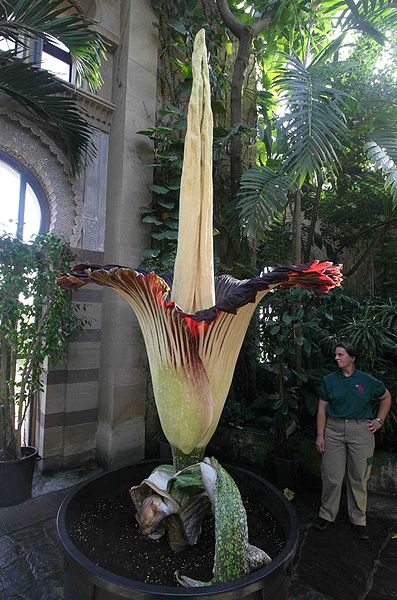
The giant misshapen phallus flower

Fractal Broccoli
Amorphophallus titanum
Amorphophallus titanum, which loosely translates as "the giant misshapen phallus", produces the world's largest flower. The flower can be over 10 feet tall at its apex. Both in its native Sumatra, and under cultivation in botanical gardens world wide, the Amorphophallus flowers only rarely, which might be good since this huge bloom also gives off a huge smell. Its odor is similar to that of a decomposing animal, which attracts the insects that help in its pollination.

Monday, March 12, 2012

Big and smelly

Aristolochia grandiflora 1
Aristolochia grandiflora (Pelican flower)
The Pelican flower plant makes huge heart-shaped flowers which are over a foot long. But the gargantuan size also comes with a gargantuan smell that's been compared to the smell of a dead rodent. Native to Central America, this vine is a favorite of botanical gardens. 

Tuesday, March 6, 2012

Guest Blog: Yuval Sapir and Iris SROs

Dr. Yuval Sapir is Director of the Tel Aviv University Botanical Gardens

Royal Irises are among the most prominent flowers to bloom in the Israeli Spring. This group of species includes the largest flowers in the Middle East, with some as large as Mike Tyson's boxing gloves. Not only large, these flowers are oddly dark-colored. For example, the Gilboa Iris (Iris haynei [picture]) is purple, and other species can be as dark as black. How did this conspicuous dark color evolve?

These huge flowers double as SROs (single room occupancy units) for solitary male bees that sleep overnight in the flowers. These poor males are not allowed in the safe borrows of the females, who nest in the ground. Instead, they are banished for the night to look for a safe refuge from their predators. Iris flowers provide the perfect hospice. Following sunrise, rays from the morning sun heat the dark-colored flowers.  The inside of the flower quickly heats up, and with it, the resident sleeping bee. The warmed-up bee can then start its daily activities earlier than colder bees which slept outside. On its way out of the Iris, the bee picks up some pollen, which it carries around with him in its search for food (nectar) and sex (female bees).

The following evening, tired from his day and still carrying the Iris pollen, the male remembers to go back to his safe and warm Iris-shelter. Upon entering the flower, the pollen-carrying male brushes against the flower's stigma, pollinating the flower.

So here we have the answer to the evolution of the dark-colored irises - the dark color was selected for by the pollinators who preferred a night shelter that promise them a warm place to wake-up in.

Tuesday, February 28, 2012

Poppies

Papaver somniferum flowers
Papaver someniferum (Opium poppy)
What would life be like without the opium poppy? No poppy seed bagels. No beautiful poppy flowers. No Dorothy falling asleep in the poppy fields in the Wizard of Oz. No morphine or codeine. The use of poppy as a pain killer is probably it's claim to fame and, when misused as in heroin, to infamy. The medicinal uses of opium poppy have been known for thousands of years. Turkey, India and surprisingly Australia, provide most of the worlds legal opium poppy. I once saw some opium poppy growing in a road divider on the way to Hadassah Hospital. Obviously it was planted for convenient use in the hospital, and not for any illicit uses.

Thursday, February 9, 2012

Guest Blog: Mollie Cox Bryan and Morning Glories

Mollie Cox Bryan is an author, scrap-booker, blogger and childhood friend. The first book in her new mystery series, A SCRAPBOOK OF SECRETS, was just published.
Blue Morning glories
Add caption
Are Morning Glories sneaky? I confess that sometimes I really think certain plants and flowers have a personality. I love the flowers—the vibrant colors, the way they open in the morning and then fold during the day. Part of the joy I take in them is that they are little survivors and opportunists, popping up everywhere in my backyard—which is exactly what my husband hates about them. Where I see a charm, he sees the need for order. Oh well. But the little sneaky, beautiful flower has found its way into my first novel—SCRAPBOOK OF SECRETS: A CUMBERLAND CREEK MYSTERY. The copy editor asked why so many Morning Glories. (Perhaps copy editors and orderly husbands have something in common?) I responded that I live in Virginia, my book is set in Virginia, and I love the flower. She didn’t press the issue—so my Morning Glories are safe, at least in my novel.

Danny: There are hundreds of different varieties of Morning Glories. One Japanese variety, Shidare-asagao, is particularly interesting for scientists because it has lost its balance. Plants, like people, have a sense of balance that allows them to know up from down. Just as we know when we're upside down, or just lying down, a plant also knows when its not vertical. Plants shift their growth according to gravity. That's why plant shoots always grow up, and roots always grow down (you can test this at home by placing a plant and its pot on its side). Shidare-asagao though has lost its sense of gravity. Rather than growing up, its shoots fall down. This makes for a great hanging plant.

Monday, February 6, 2012

Guest Blog: Yuval Sapir - Mr. and Ms. Almond


Almond trees bloom in the midst of winter, exposed to rain and wind. This is also the same time of the year that has an almost complete lack of pollinators. So how do these trees make fruits?

Well, on rare sunny winter days, these trees are visited by large solitary Anthophora bees. Each bee can visit a single tree hundreds of times. But even with these visits of pollinators, only a tiny fraction (5 - 10%) of flowers set fruit, which seems like a huge waste of flowers. Why such a waste?

The answer is probably due to the difference between males and females (I'm talking about trees here, but the case could be made for humans as well). Males seek different paths of reproductive success than females. The male parts of the almond trees (which produce the pollen) benefit from each bee visit as more and more pollen is spread to other trees. The huge number of flowers is a very attractive advertisement for the bees to come get pollen. The larger the advertisement, the better chances of male success. The large cover of thousands flowers attracts many more bees that carry pollen away, which increases the chances of male success.

The female parts of the tree (which is the style and ovules), on the other hand, enjoys the privilege of "choosing" the best pollen grains and being picky. Only the most fit male will make it to the ovule and produce a fruit, otherwise an abortion will be its fate. So only a twentieth of flowers set fruits, but these will be the best kids for mom!

Thursday, January 12, 2012

Furry Females


Acalypha hispida (Chenille plant) 
Tel Aviv University Botanic Garden photo: Eytan Chamovitz
The Chenille plant is native to Oceania, but has been cultivated around the world due to its beautiful furry flowers. The plant is dioecious, meaning that there are distinct male and female plants, and of course only the females have the distinctive flowers.