Showing posts with label ethnobotany. Show all posts

Monday, October 5, 2015

2015 Nobel Prize highlights importance of botanical chemistry

1600 years ago, a Chinese physician wrote in a book called "Emergency Prescriptions Kept Up One's Sleeve", that soaking a plant now known as Artemisia annua  in water, and then drinking the juice, can reduce fever. This text was rediscovered in the second half of the 20th century by a then obscure Chinese pharmacologist, Tu Youyou. Ms Tu was working on a secret project to find a novel cure for malaria. She found that artemisia extract was highly efficient in combating the malaria parasite. Her work led to the development of the drug artemisinin, which is now widely used in malaria treatment in Africa.  Ms. Tu's role in the discovery of artemisinin remained hidden from the West for most of her life. But now at the age of 85, she has been recognized with the 2015 Nobel Prize in Medicine for her work
An illustration describing Ms Tu's work displayed during the press conference announcing the winners of the Nobel Medicine Prize. Linked from and The Telegraph: Nobel Prize for Chinese traditional medicine expert who developed malaria cure. Photo: AFP


This reminds us that many of our medicines have their roots in botany. The ancient Greek physician Hippocrates described a bitter substance, now known to be salicylic acid, from willow bark that could ease aches and reduce fevers. Other cultures in the ancient Middle East also used willow bark as a medicine, as did Native Americans. Centuries later, we know salicylic acid as the chemical precursor for aspirin (which is acetylsalicylic acid), and salicylic acid itself is a key ingredient in many modern anti-acne face washes.

The Pacific Yew is a conifer found primarily in the Pacific Northwest. Its thin scaly back would probably go unnoticed if not for the fact that it contains a chemical called paclitaxel, or more commonly known as the chemotherapy drug Taxol. Taxol was discovered in the mid 1960s as part of a large-scale program to identify natural products which might be used against cancer. In 1992 Taxol was approved by the FDA for use in fighting breast, ovarian and lung (and a few other) cancers.

And what would life be like without the opium poppy, the source of morphine or codeine. The medicinal (and likely recreational) uses of opium poppy have been known for thousands of years. And the increasingly legal uses of cannabinoids in western medical protocols cannot be ignored.

These are prime examples of how a deep knowledge of botanical diversity and chemistry can lead to incredibly important applications.

Unfortunately, education towards and development of expertise in these fields over the past decades were not a priority for many universities, where plant biology outside of the study of model organisms was looked down upon. At Tel Aviv University we've recognized the importance of botanical pharmacology. As Dean of the Faculty of Life Sciences, together with the Dean of the Faculty of Medicine, we have initiated a search for a botanical pharmacologist whose position will be divided between our two Faculties, between plant biology and pharmacology. Such interdisciplinary research is critical for exploiting the medicinal potential hidden in plants.

Sunday, September 30, 2012

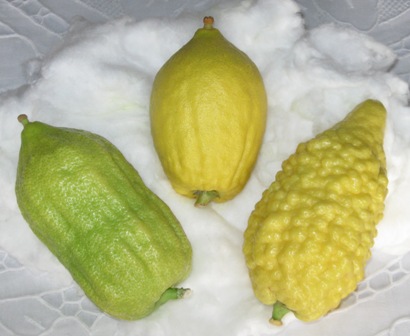
The Citron of the Tabernacles

Varieties of Citron (citrus medica)
Oranges, grapefruits and lemons, tangerines, limes and maybe even a pomelo are types of citrus fruits we eat, or juice, all the time. But how many of you are familiar with the citron?

The citron has been around for thousands of years, and when crossed with other species, gave rise to the different citrus varieties we know and love today. But aside from its fragrance, the citron does not have many redeeming qualities, especially as it is almost devoid of juice and has a thick rind. While this can be candied to make succade, the citron's main uses have been religious.

The small etrog I bought for this year's Sukkot holiday
In the Book of Leviticus it is written: "And you shall take on the 1st day (of the Feast of Tabernacles, Sukkot) the fruit of beautiful trees...". The citron, known in Hebrew as the etrog, has always been assumed to be this fruit, as indeed the literal translation of the Hebrew word for "citrus" is eitz hadar, which literally translates as "beautiful tree". Because god commands us to use the etrog during the Feast of Tabernacles, the trade in citron, and especially beautiful unblemished fruit, can get competitive and expensive. The search for the perfect etrog was even the subject for an excellent movie, Ushpizin, which I highly recommend.

Happy Sukkot!

Sunday, September 16, 2012

An Apple for the New Year

"Why do we need so many kinds of apples? Because there are so many folks. A person has a right to gratify his legitimate taste. If he wants twenty or forty kinds of apples for his personal use…he should be accorded the privilege. There is merit in variety itself. It provides more contact with life, and leads away from uniformity and monotony." -- Liberty Hyde Baily

In the spirit of the Jewish New Year, some apple facts:
  • Origins: Khazakistan (Thanks Borat!) and surrounnding regions in Central Asia
  • # of genes (in Golden delicious): 57,000 (more than any other plant so far)
  • First eaten by: Eve
  • # of cultivars: 7,500
  • amount grown in 2010: 60 million tonnes
  • Largest grower: China
  • Largest grower in US: Washington

And lastly, for those going to a Rosh Hashana meal, here is the proper way to dip an apple in honey:


Sunday, July 22, 2012

Fun with Gat

Catha edulis (gat)
Catha edulis, better known as gat or khat, is native to Yemen and the Horn of Africa.  Locals chew on the leaves, which releases small concentrations of a neuroactive alkaloid called cathinone.  This stimulates the cental nervous system, and according to gat chewers, increase endurance, gives a feeling of strength and health, suppresses hunger (which is an advantage in areas known for chronic famine) and tiredness (which is an adavantage during hard labor and long walks). Because the leaves contain so little cathinone, large qauntitites of leaves have to be cchewed to get any effect. Consequently, gat-chewing is a social experience with groups of men or women sitting around and chewing and conversing together. In Yemen gat is so popular that 40% of the county's water supply is dedicated to gat agriculture!

Hagigat in Tel Aviv
Of course western culture doesn't have time for hours of leaf chewing (or the stomachs to see people spitting out the leaves and juice, though this to me seems no different than chewing tobacco). An Israeli biochemistry student working for some shady characters isolated cathinone from gat, who then marketed it in a concentrated pill called hagigat, which loosely translates to "party gat". While initially legal, hagigat soon became abused in the local party scene, was connected to several hospitalizations due to damage to the cardiac and central nervous systems, and was added to the list of illegal drugs. 


Gat itself though is still legal in Israel and many other countries. Apparently, its difficult to abuse something that you have to chew for hours. 


Thursday, June 14, 2012

Guest Blog Linda Leaming: Meeting Himalayan Medicinal Plants


Linda Leaming lives in paradise. Her book MARRIED TO BHUTAN is the story of her life in one of the most magical and beautiful places on earth, the Himalayan Kingdom of Bhutan.

The caretaker's garden
I never feel more happy or alive than when I'm walking in the mountains of Bhutan. One of my favorite walks is to WangdueTse (Wang-d-SAY), a famous, old temple on the outskirts of Thimphu with giant iron statues and an ancient mud floor. It takes half a day from my house in the hills above the city, and it's a marvelous escape into another world. The hike takes me down the big hill where we live, around the bend and then up the switchback road to Sangaygang (San-GAY-gang). At Sangaygang, high above the city, I walk past the caretaker's cottage and note his nice garden, and then it's over a big mound and I'm in the woods headed to the temple.

Khempa (Tibetan Sage)


Surrounded by the forest, there's that insular, rich aroma of nature and life. Rotting plants, pine sap, urine, fresh air, flowers, and wood smoke, all blend together, and it's the smell I love most. One plant, called khempa by the Bhutanese, is gloriously making itself known on the edge of the trail this spring morning. It has a sort of pungent, musky, eucalyptus smell and is used liberally here as a medicinal plant. A spoonful of the juice helps with sinusitis, and a hot bath with an armful of its leaves will cure back pain. Bhutan in the Himalayas is the land of medicinal plants. There are over of them 500 cataloged, and many as yet unrecorded. In Thimphu we live near the Traditional Hospital, which uses many traditional herbs and plants for healing. Here's a blog post I wrote about going to the traditional hospital.
    

Wednesday, June 6, 2012

Native or Immigrant? The prickly pear's identity crisis

This is the flower which will develop into a prickly pear. The young fruit can be already seen growing under the flower, and a few more mature ones grow behind it.

Prickly pear cacti grow all over Israel and the Middle East in general, where they are used not only to produce the tasty fruit, but also as borders between houses and villages. The cactus is so omnipresent that most people think the prickly pear to be endogenous to the Middle East. Israelies have taken this one step further and have adopted the Hebrew name for the prickly pear (tzabar) (Sabra in English) to describe native born Israelis. Like the fruit, a tzabar is thought to be prickly and dangerous on the outside, but soft and sweet inside.

In reality though, the prickly pear may be an imposter. While it pretends to be native, it is actually a new immigrant (in Hebrew, an oleh). Molecular DNA studies indicated that the prickly pear of the Middle East, Opuntia ficus-indica, is actually an import from Mexico! Many European traders carried the prickly pear on board to prevent scurvy, and then transplanted the cacti around the Mediterranean. 

As a new immigrant, I can now proudly declare myself a tzabar !

Tuesday, May 15, 2012

Pretty but poisonous

Calia secundiflora flowers
Sophora secundaflora (Texas mountain laurel)
The Texas Mountain Laurel is a lovely small tree with bunches of bright blue flowers. These flowers yield bright red seeds which Native Americans used as ornaments and jewelry, but also as an hallucinogen. The seeds can be used to make a drink which when dilute leads to hallucinations, but at higher doses is poisonous. The toxic compound, cytisine, causes paralyses which leads to suffocation.

Saturday, April 28, 2012

Hula skirts

Cordyline fruiticosa (Cabbage Palm)
The leaves of the Cabbage Palm (known as La'i in Hawaiian and Lauti in Samoan) are used to make Hawaiian hula skirts and the Tongan sisi dance dress. In Hawaiian lore, the plant has great spiritual power and even today is considered a good luck charm.  The leaves are so strong that they can sewn together and ridden in lava sledding (a traditional Hawaiian sport that's a cross between surfing and snow sledding)!

The strength of the leaves comes from the cellulose fibers, which are found in all leaves, but are especially thick in cabbage palm leaves. Chemically, cellulose, one of nature's strongest natural materials, is very similar to starch, one of the stickiest. Both are made of the sugar glucose, but with a slight difference. In starch the the glucose is arranged such that there's room for lots of water to surround it, which leads to its sticky nature. In cellulose the glucose is arranged such that long strings of the sugar bind to each other and exclude all water. This leads to a compact, highly stable, and very strong structure that per weight, is stronger than steel.

Sunday, April 22, 2012

Methuselah, the 2000 year old date

The Methuselah date palm, 2012
Kibbutz Keturah, Israel
The date palm has been a source of food, medicine, shelter and shade for thousands of years. While the exact date trees grown in the bibical period are long extinct, in 2005, a 2000-year-old date seed recovered from Masada in the Judean dessert was successfully germinated. Genetic analyses have shown that this tree is distinct from all known date palms, and scientists want to see if the ancient tree has any unique medicinal properties no longer found in today's date palm varieties.


Unfortunately, Methuselah, true to its name, appears to be male, so we won't get any ancient fruit. Date palms are dioecious, meaning that there are separate male trees which make pollen, and female trees which make ovules which lead to fruit and seeds after fertilization with pollen from the male. But through careful genetic breeding, Methuselah can be used to pollinate modern species, and some of these offspring will be female. These hybrids can then be recrossed with Methuselah's pollen, to yield a new generation that's mainly the ancient date.

Friday, April 6, 2012

Is Marijuana Kosher for Passover?

In the spirit of the Passover Holiday, I couldn't resist commenting on this. High Times, which since 1974 has been spreading the gospel of legalizing pot, has run an article asking the obvious question, can a person get high on Passover and still be religious?

This may not be as absurd as it seems, as the question on what is kosher for Passover, and what isn't, is taken very seriously in some circles, and can even lead to familial conflict. For example, when I was a kid, rice was verboten as it is for all Ashkenazi Jews. This is NOT because rice is a leavened product. Indeed the Talmud clearly states that rice should be eaten at Seder to commemorate sacrifices at the temple. But a few hundred years ago European rabbi's decided that rice COULD be contaminated with wheat, and this should not be eaten during Passover. This prohibition was expanded to include other grains and legumes. The overall effect on the Ashkenazi digestive system is best left not discussed.

Sephardi Jews though never adopted this extreme position, and as such their seders contain rice and a variety of foods I could only dream about. So I was totally shocked 30 years ago to find out that my wife's family eats rice on passover! Not that my wife is Sephardi, but her family had years ago adopted the customs of one of the uncles by marriage. It didn't take long until I also became a convert.

Which then leads us to the question of marijuana. Now under no condition should this be construe as a call for illegal activity (for those unfortunante places where marijuana is still considered a controlled illegal substance)! But IF one were to partake in any illegal activity, is it still kosher (for Passover that is)?

The article concludes that marijuana would fall under the classification of legumes, which means that, as always, the Sephardim get to have all the fun.


Wednesday, April 4, 2012

And the people of Israel called the bread "manna"

The Book of Exodus gives several descriptions of the food provided by God for the Jews as they meandered through the dessert. Manna is described as fine,white flakes that melt in the sun, and taste like wafers made with honey. Like all fresh food, manna came with a "best used by..." date, which in this case was "best used by tomorrow". If collected and stored, manna became infested with worms and rotted (yech!).

So can we define the botanical basis of manna? This is a slippery slope where scientists try to merge their craft with religion, but this hasn't deterred a number of hypotheses. Manna has been claimed to have come from tamarisk trees, which excrete a sweet, melt-able resin; insect honeydoo (bug poo in other words) which is actually edible; lichens, mushrooms or even locusts.

Regardless of what it was, manna was not a food of choice. Back in Egypt, the Children of Israel would not had subsisted on bug poo or lichens. But as they were obviously suffering from problems of food security, God provided the Israelites with daily rations of manna. The manna provided basic subsistence, but not much variety. Manna could be compared to corn meal provided by the USA to Africa - its not the food that they'd choose, but given the alternatives, it did provide nutrition!

Happy Passover!

Thursday, March 15, 2012

The cannonball fruit

Crescentia cujete fruit
Crescentia cujete fruit (Calabash tree)
The Calabash tree is found in tropical jungles of Central and South America. This tree produces a huge fruit that resembles (and weighs like) a cannonball. When fresh, the fruit is eaten. When dried and smoked, the fruit covering is used by native peoples as a container for food and liquids, as a cup, as a ladle, and even as a musical instrument (called the maraca). The fruit seeds contain an oil that's used as a medicine against colds.

Tuesday, February 14, 2012

Guest blog: Tovar Cerulli and Blueberries

Tovar Cerulli is an author and reformed vegan-turned-hunter. His book The Mindful Carnivore: A Vegetarian's Hunt for Sustenance was just released.

Blueberries
Wild blueberries Vaccinium corymbosum

Blueberries were my first wild food, and have remained my most constant.

As a boy, growing up here in New England, I sought them in the pine and oak woods around my father’s house. Small, sweet, and dusty blue, they hung in clusters, concealed by the leaves of the ground-hugging bushes. With a quart container filled, I would head back to the house, where my father mixed them into pancake batter, dropped by the ladleful onto a sizzling griddle.

In my twenties, as a vegan, I continued to pick them and savor the fullness of their taste.

Even today—when the wild foods in our kitchen include everything from white-tailed deer and fiddleheads to chanterelles and indigo milk caps—there is something special about stumbling onto a patch of blueberry bushes.

Heavy with fruit, they might cling to crevices in the rocky hillside my wife and I have been hiking. On a warm summer day, the berries come as unexpected gifts: morsels of transmuted earth, sun, and soil. I dig a plastic bag out of my pack and we start picking and snacking. Half an hour and two quarts later, we’ve hardly made a dent.

Walking away, we talk about what we’ll make with them. Yes, I’ll make some pancakes. Yes, Cath will make a batch of jam. Assuming enough berries make it back to the kitchen.

Danny: Blueberries are native to North America. They are often confused with the European bilberries, which while similar in appearance and taste, are a different species. While blueberries are obviously essential for muffins and pancakes, a recent study has indicated that daily blueberry consumption can improve memory functioning, at least in older adults with impaired memory.

Monday, January 30, 2012

The Indian Date

Tamarind tree
Tamarindus indica (Tamarind)
The Tamarind tree is little known in the west, but common in Africa and Asia. It name comes from the Arabic and Hebrew words tamar , which means "date", and hind, which means "India". Its fruit can be eaten, turned into a drink, or used to flavor ice cream. Both its fruit and bark are used in traditional medicines and modern studies have shown that they contain chemicals that can work as anitibiotics. In Asian temples, the fruit pulp is used to polish brass Buddhas.

Sunday, January 8, 2012

Umkokola - A smelly apple

Dovyalis caffra00
Dovyalis caffra (Umkokola)
The Kei apple, or Umkokola, is native to southern and eastern Africa. This small tree yields an edible fruit, about the size of a crab apple. The little-known fruit is a traditional food in Africa and could be used to promote local food security issues. Umkokola fruits contain more vitamin C than an orange! But the fruit is rather smelly which has hindered its adoption as a crop.

Thursday, January 5, 2012

No yams, no Pill

Dioscorea mexicana (Mexican yam).
photo by Nhu Nguyen
Mexican yams were the original source of the chemicals that were used in the first oral contraceptives (affectionately known as The Pill) in the mid-20th century. These inedible wild yams (not to be confused with sweet potatoes, which belong to a different family of plants, but are are sometimes mistakenly referred to as "yams")  contain a chemical called diosgenin, a type of phytoestrogen. Scientists at the Mexican pharmaceutical company Syntex extracted Diosgenin from these yams and used it to make progesterone which in turn was used in the early versions of The Pill. In nature, Mexican yams are found in the rain forests of southern Mexico and Central American and are cultivated today primarily for the interesting "turtle shell" look of the tuber root.

Monday, January 2, 2012

Guest Blog: Paul Moore and the Mt. Atlas Pistachio

Paul Moore is a musician, traveling minstrel, founder of Ukuleles for Peace, and a lover of trees.

Pistacia atlantica
Paul Moore and a very old Pistacia atlantica (Mt. Atlas mastic)

Paul: I found this today while on a trip to look at stone for my house. This amazing Mount Atlas Pistache tree is next to Kibbutz Yiftah on the Northern Road of Israel. This could be the oldest one in the grove, or one like it, and is approximately 450yrs old. The most strange thing happened as I approached it: a Black cat jump out from the Center of the Tree... A witch's Tree no doubt! I am lucky to Live in a Forest in the Galilee Mountains in Mitzpa Harashim, We take our love of trees very seriously here! I hope to take pictures and tell more tree story's in the Future. The Galilee has an amazing amount of very old trees despite its size and the constant removal of trees over the centuries for fire, carpentry and more recently the railway. The Sacredness of some trees is still very much part of the inhabitants, be they Jew, Christian, Druze, or Muslim.

Danny: This species of pistachio is native from Iran to Turkey, through the Middle East to North Africa. It has many uses: The seeds can be eaten raw or turned into candy, the seeds also provide a useful oil, the plant contains a rubber that is used as a natural chewing gum, its sap is used to make incense and perfume, and the leaves contain chemicals used for tanning leather. The Mt. Atlas tree is dioecious, meaning that there are separate male and female trees.


Thursday, December 29, 2011

A not so merry Christmas?

Boswellia-sacra-greenhouse
Bosweillia sacra (Frankincense tree)
Frankincense, a traditional staple of the Christmas story, is produced from the resin of Bosweillia trees  much in the same way that syrup is tapped from Maple trees. The smallish Bosweillia tree is native to the southern Arabian penninsula and the neighboring Horn of Africa . A recent study has shown that Bosweilla populations are in severe decline due to over-harvest, with the number of trees projected to decrease by one half within 15 years, and to be wiped out by the middle of the century. This would leave the Catholic church, one of the main consumers in frankincense, with a big problem. In addition to its religeous uses (or maybe explaining them) frankincense smoke is psychoactive and may relieve depression and anxiety!